A thrust is an area of research focus at the Center for Neurotechnology (CNT), and it encompasses the fundamental knowledge and foundational research that our experts bring to the center. These research thrusts feed into already-existing technologies that we are using and new technologies we are developing and integrating into our testbeds.
Each CNT project reflects the contribution of these research thrusts:
Experimental Neuroscience
Led by Eberhard Fetz and Richard Andersen, the Experimental Neuroscience Thrust uncovers principles of engineered neuroplasticity in animal models and humans.
Computational Neuroscience
Led by Rajesh Rao and Eric Shea-Brown, the Computational Neuroscience Thrust aims to better understand neural circuit dynamics and develops co-adaptive mathematical algorithms for inducing neuroplasticity in the brain and spinal cord.
Communication and Interface
Led by Josh Smith and Sam Kassegne, the Communication and Interface Thrust works on designs for enhancing the CNT’s Neurochip research platform, as well as multifunctional electrodes for engineering neuroplasticity in the brain and spinal cord.
Neuroethics
Led by Sara Goering and Eran Klein, the Neuroethics Thrust studies how ethical issues such as identity, privacy, agency and moral or legal responsibility are intertwined with neural technologies.
Each research thrust works both independently and collaboratively to enhance center-wide knowledge discovery and development. Neuroethics researchers collaborate across all research projects.
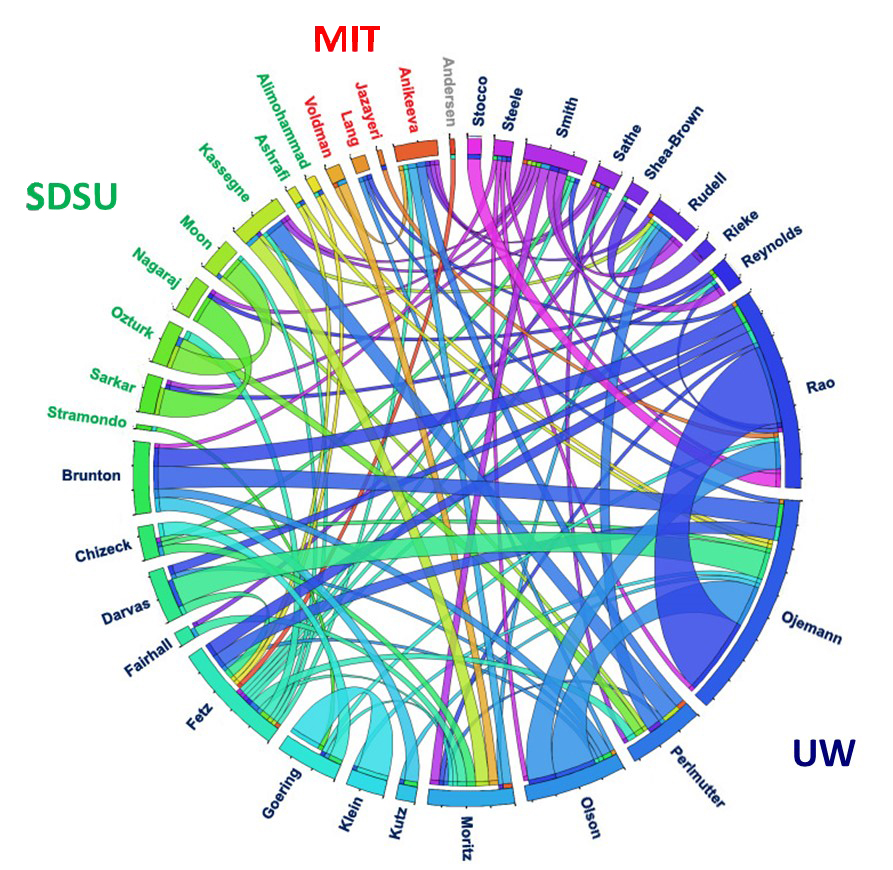
Pictured below is a graphic representation of research collaborations between CNT members at the University of Washington (UW), the Massachusetts Institute of Technology (MIT) and San Diego State University (SDSU). Thicker lines represent more frequent collaborative work.